will saudi celebrate md birth birthday
No, Saudi Arabia does not celebrate Mawlid (the Prophet Muhammad’s birthday) as an official public holiday or with widespread festivities because its Salafi interpretation of Islam prohibits the practice as an innovation not recorded in the Quran or Sunnah, though religious lectures on his life and teachings are held instead.
editor note: (here in india converted muslims try fight with hundi sumrituals)
What is the “I Love Muhammad” controversy
-
The controversy began during a Barawafat procession in Rawatpur, Kanpur (Uttar Pradesh) on September 4, 2025. Barawafat is the observance/milad for Prophet Muhammad’s birth.
-
In the procession route, a light board/banner was installed reading “I Love Mohammad / I Love Muhammad”, in front of a locality (Jafar Wali Gali, Saiyad Nagar) which is near a public road traditionally used by Ram Navami processions (a Hindu festival).
-
Some people from the Hindu community objected, saying that this was a “new tradition” being introduced in a space or procession route that had traditional practices.
-
The dispute escalated: the banner/light board was removed or relocated by police, uproar followed, and an FIR (First Information Report, legal case) was filed against several Muslim youth (named and unnamed) for allegedly disturbing communal harmony, promoting enmity under relevant sections of Indian law.
How it spread / what followed
-
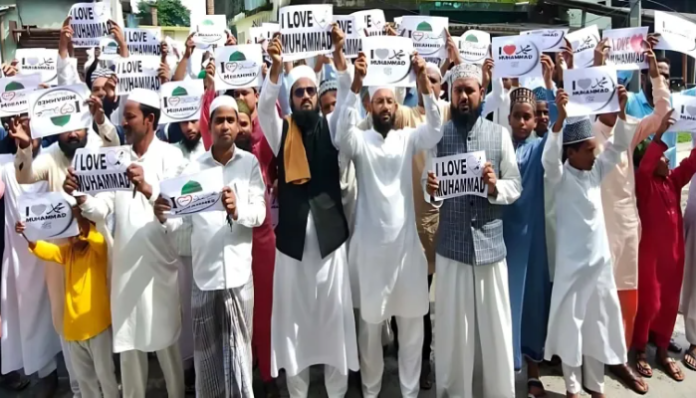
Following Kanpur, the issue has spread to multiple cities/states: Unnao, Bareilly, Lucknow, Uttarakhand (Kashipur), Nagpur, Hyderabad, etc. Protests, processions, and rallies have taken place by those supporting the right to express “I Love Muhammad.”
-
Muslim organisations, civil society, and political leaders have pushed back, saying expressing love for the Prophet is not a crime and that the FIRs are suppressing religious freedom or freedom of expression.
-
Some clashes with police, some arrests, public protests, social media campaigns. The slogan or banner has become an assertion of faith for many.
Main points of contention / what are people arguing about
Here are the key conflicting perspectives:
| Issue | One Side’s Argument | Other Side’s Argument |
|---|---|---|
| Religious Expression | Putting up “I Love Muhammad” is a peaceful expression of love/devotion to the Prophet. Should be allowed. | Says that installing banners in public roads or changing procession routes without consent can infringe on communal practices, norms, law & order. |
| “New Tradition” / Procession Norms | Supporters say traditions evolve; banishing such expressions is unjust. | Opponents say changing tradition in religious processions without involvement of local custom or administrative approval can provoke communal tension. |
| Law Enforcement / FIRs | FIRs are unjust and targeting Muslims for religious expression; being selective. | Police argue FIRs registered over actions (e.g. placement of banner, removal of other groups’ posters, damage of posters) that are alleged to have disturbed communal harmony under law. |
| Public Order & Communal Harmony | Many protesters say the issue is being blown up, or antagonised by political groups. | Authorities say that any public display has potential to cause communal friction, so law should apply to all. |
Why this is causing strong reactions
A few reasons why this relatively simple slogan “I Love Muhammad” has become a big controversy:
-
Communal Sensitivities: India has many places where religious processions, routes, installations etc. are highly overlapped between different communities. Any perceived change can be seen as threatening or provocative.
-
Tradition vs Change: The claim that something new is being introduced in a procession that follows long-standing tradition; this is a flashpoint.
-
Freedom of Expression vs Limitations: The balance between religious freedom and restrictions under law (when something is said to disturb public order or law & order) is often contentious.
-
Political Overtones: Politicians and religious leaders on both sides have seized upon the issue. Media coverage amplifies it.
-
Social Media Amplification: Posts, hashtag campaigns, videos have spread the message and also backlash, possibly intensifying the situation.
Legal / Constitutional Aspects
-
India’s Constitution guarantees freedom of religion (Art. 25) and freedom of expression under certain limits. But there are legal restrictions: removal of banners without permission, statements that promote enmity between groups (Section 153A IPC), deliberate acts to outrage religious feelings (Section 295A), etc.
-
The police FIRs are under such laws. The question is whether just putting up “I Love Muhammad” qualifies as violating any such law or whether the actions around it (location, process, associated damage or removal of other religious symbols) are what triggered legal response.
Current status (as of late Sep 2025)
-
FIRs in Kanpur for several named and unnamed individuals.
-
Protests ongoing in multiple cities. Demands to withdraw FIRs.
-
Some authorities saying that the banner itself is not the issue but the way it was done (installation in public road without permission, placement conflicting with tradition) is problematic.
-
Spread of Protests
-
The issue that began in Kanpur (Uttar Pradesh) has now spread to multiple states, including Uttarakhand, Telangana, Maharashtra, and others.
-
Cities where rallies, processions, or demonstrations have been held include Bareilly, Lucknow, Kaushambi, Maharajganj, Kashipur, Nagpur, Hyderabad, etc.
-
-
Demands to Withdraw FIRs
-
Many rights groups, religious leaders, and community organisations are demanding that the FIRs filed in Kanpur (and elsewhere) be withdrawn. They argue that the “I Love Muhammad” slogan itself is not a crime.
-
For example, in Bareilly, the Imam of Jama Masjid (Mufti Khurshid Alam) has urged community members to put up “I Love Muhammad” posters and called the FIR “arbitrary”.
-
-
Legal Cases / FIRs Details
-
In Kanpur, an FIR was filed on 9 September 2025: nine named and 15 unnamed persons were accused.
-
The charges include disturbing communal harmony, introducing a “new custom” in the Barawafat procession, and erecting boards/tents in public roads outside traditional norms.
-
Police also contend that there was damage to religious posters belonging to Hindu groups, etc.
-
-
Clarifications from Authorities
-
Police have clarified that the slogan “I Love Muhammad” per se is not illegal (i.e. the FIR is not filed solely for the phrase). Instead, the allegations are about changing tents/structures, placing board in a location not used traditionally, and damage to others’ posters.
-
They emphasise maintaining “custom/tradition” of processions, permission requirements for structures on public roads, etc.
-
-
Social / Symbolic Campaigns
-
As a response, there are symbolic protests — banners, posters, flags, social media posts with “I Love Muhammad”.
-
In Bareilly, Kutuabkhana, etc., people have rallied after prayers showing the slogan.
-
-
Tensions and Incidents
-
Some clashes with police, stone-pelting, property damage in a few places.
-
In places like Kashipur (Uttarakhand), an “unauthorised procession” is said to have led to clashes.
-
⚠ What’s Still Unclear or Pending
-
Whether the FIRs will be withdrawn. So far, government/police have not given any official promise to drop them.
-
Identification and arrest of all the unnamed accused are ongoing.
-
Outcome of legal proceedings — court dates, hearings, police actions etc. Not yet reported in detail.
-
How higher courts or the state/national government will address the tension between freedom of expression/religion and public order/tradition in this case.
-
Whether changes will be made to how processions and public religious displays are regulated (permissions, route norms, what counts as “new tradition”).
⚖ Legal / Political Responses
-
Politicians and religious leaders from Muslim community are strongly backing the idea that expressing love for the Prophet is constitutional and should not be criminalised.
-
On the other side, authorities are justifying actions based on law and order, public permissions, custom/procession norms, arguing that any new structures or boards placed on roads require permissions.
-
Some Hindu groups are supporting or backing police objections, saying traditional routes or practices are being disrupted.
