The demand for protecting locals from outsiders in business, land, and employment has grown stronger in Telangana, especially after recent debates around non-local dominance in trade. Many Indian states and even foreign countries have already adopted policies to safeguard their residents. The proposed Telangana Local Protection Act 2025 could draw inspiration from both Indian precedents and international models to ensure balanced growth while protecting local identity.
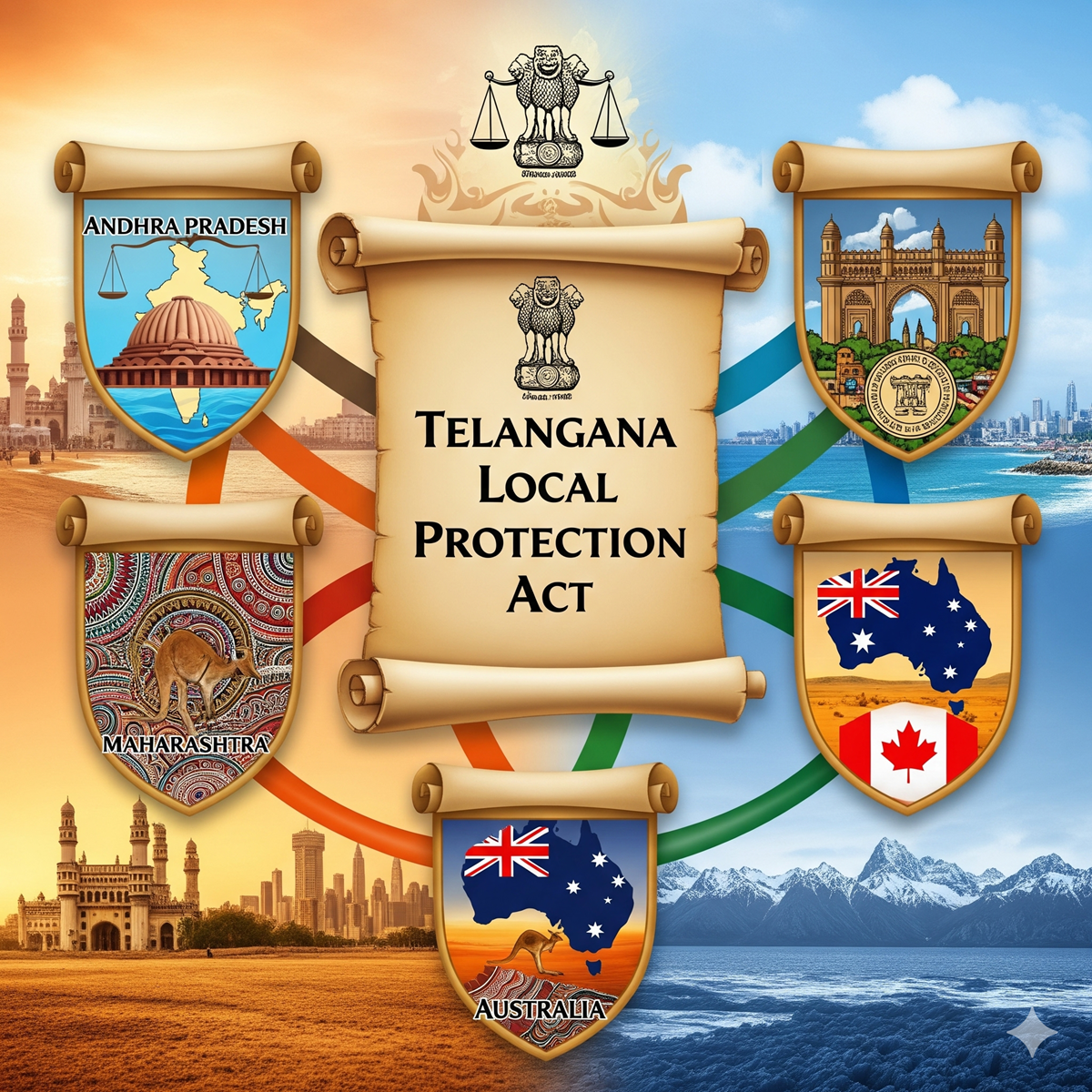
Overview of Local Protection Policies
Local protection measures typically focus on three areas:
-
Land Ownership Restrictions – Limiting outsider access to agricultural or residential land.
-
Business & Licensing Rules – Prioritizing locals in trade permits and contracts.
-
Employment Quotas – Reserving jobs for state residents in private and public sectors.
Indian Examples of Local Protection
🔹 Andhra Pradesh
-
The Andhra Pradesh Employment of Local Candidates in Industries Act, 2019 reserves 75% of private sector jobs for state residents.
-
Industries must hire locals first and provide training programs if skills are lacking.
🔹 Maharashtra
-
The sons-of-the-soil policy favors Marathi residents in permits, taxi licenses, and municipal trade allocations.
-
Knowledge of Marathi is often mandatory in state government jobs.
🔹 North-Eastern States
-
States like Nagaland, Mizoram, Arunachal Pradesh, and Meghalaya restrict outsiders from owning land.
-
The Inner Line Permit (ILP) system controls non-resident entry.
-
Special constitutional provisions under Article 371 and the Sixth Schedule safeguard land and cultural identity.
International Examples of Local Protection
🔹 Australia & New Zealand
-
Foreigners cannot freely purchase residential land; strict approval systems apply.
-
New Zealand bans most outsiders from buying existing homes to protect affordability.
🔹 Canada
-
In 2023, Canada imposed a two-year ban on foreign housing purchases to stabilize property prices.
🔹 Bhutan
-
Outsiders cannot own land or businesses directly.
-
Joint ventures require majority Bhutanese ownership.
🔹 Gulf Countries (UAE, Saudi Arabia, Qatar)
-
Citizens receive priority in jobs under policies like Saudization and Emiratization.
-
Trade licenses require local sponsors.
🔹 Singapore
-
Only citizens can buy public housing (HDB flats).
-
Companies must follow strict quotas for hiring foreigners.
Comparative Chart – India vs International
| Aspect | Indian Examples | International Examples | Possible Telangana Adaptation |
|---|---|---|---|
| Land Ownership | North-East: Outsiders restricted, ILP system | Australia, Canada, New Zealand: Foreign land restrictions | Limit outsider purchase of agricultural/urban land; approval required for large plots |
| Housing Affordability | No state ban, only subsidies | Canada (housing ban), Singapore (citizen-only housing) | Domicile requirement for housing schemes; outsider restrictions in real estate |
| Business Ownership | Maharashtra: permits favor locals | Bhutan: outsiders need local partners | Enforce joint ventures with locals; trade licenses linked to domicile |
| Employment Quotas | Andhra Pradesh: 75% local jobs | Saudi Arabia/UAE: local quotas; Switzerland priority to citizens | 70–75% quota for locals in industries; mandatory preference in govt contracts |
| Cultural Safeguards | North-East: Article 371 & Sixth Schedule | Bhutan: cultural-economic protection | Safeguard Telangana tribal lands and cultural zones |
| Licensing & Permits | Maharashtra: taxi, auto permits for locals | Gulf: trade licenses only with citizens | Prioritize locals for permits and contracts in Telangana |
Proposed Telangana Local Protection Act 2025 – Key Features
-
Land Regulations – Outsiders barred from buying agricultural land without approval; large urban/commercial purchases require government clearance.
-
Business Controls – Local residents given first priority in retail trade, market stalls, and permits; outsiders must form joint ventures with Telangana partners.
-
Employment Quotas – 70–75% reservation for Telangana residents in private industries; preference in state contracts and tenders.
-
Housing Safeguards – Only locals eligible for state housing schemes; restrictions on outsider purchase in certain urban zones.
-
Cultural Protection – Special safeguards for tribal and heritage zones to prevent outsider encroachment.
-
Exceptions – Strategic sectors like IT, healthcare, and higher education may remain open to specialized outsiders.
FAQs on Telangana Local Protection Act
Q1. Why does Telangana need a Local Protection Act?
To ensure fair opportunities for local residents in land, jobs, and business, while controlling outsider dominance in key sectors.
Q2. Will outsiders be completely banned from business and land in Telangana?
Not fully. Outsiders may participate with government approval, joint ventures, or in exempted industries like IT and healthcare.
Q3. Which Indian state’s model is closest to this proposal?
The Andhra Pradesh 2019 Act on local job reservation, combined with Maharashtra’s licensing policies and North-East land laws, are closest.
Q4. Are such laws constitutional in India?
They face legal challenges under equality and trade freedom rights. However, states often frame them carefully (like land laws in North-East) to withstand scrutiny.
Q5. How does this compare to international laws?
Similar restrictions exist in Canada, New Zealand, Bhutan, and Gulf countries, proving such models are common globally.
When states or regions consider protecting locals from outsiders in business, jobs, or land ownership, it usually comes under “sons of the soil” policies. But in India, such moves are highly controversial because of constitutional rights of equality, right to residence, and freedom of trade and commerce under Articles 14, 15, 16, 19, and 21.
If Telangana (or any state) were to draft an act to protect locals from outsiders in business and land, it would typically include provisions like:
Possible Provisions in Such an Act
-
Definition of Local Resident
-
Clear criteria (e.g., domicile of 15+ years, state education certificates, or parents’ residence proof).
-
-
Land Ownership Restrictions
-
Bar or limit non-domiciles from purchasing agricultural land.
-
Require prior government approval for outsiders buying commercial or residential land above a certain size.
-
Preference to locals in allotment of industrial plots, markets, or real estate.
-
-
Business & Trade Regulation
-
Licensing rules that prioritize locals in small-scale trade, retail shops, and transport permits (similar to taxi/auto permits).
-
Outsiders may need local partnerships or joint ventures.
-
Reservation in state-run markets, mandis, or contracts for local traders.
-
-
Employment & Industrial Policy
-
Mandatory local quota in private industries (like Andhra Pradesh 2019 law requiring 75% local jobs in industries).
-
Incentives (tax breaks, subsidies) for businesses hiring a higher percentage of locals.
-
-
Safeguards & Exceptions
-
Essential sectors (healthcare, IT, higher education) exempt from strict domicile rules.
-
Outsiders allowed only if skills are unavailable locally.
-
-
Dispute Redressal Mechanism
-
A state-level tribunal or committee to handle grievances regarding land/business ownership disputes between locals and outsiders.
-
⚖️ But Legally:
-
Many such laws face constitutional challenges because the Right to Equality and Freedom of Trade across India are guaranteed.
-
States can, however, regulate agricultural land ownership (under Entry 18, State List of Constitution).
-
For business, they usually adopt indirect measures like licensing rules, subsidies, or incentives for locals instead of outright bans.
👉 Examples:
-
Maharashtra: Shiv Sena pushed for priority to Maharashtrians in jobs/business permits.
-
Andhra Pradesh 2019 Act: Reservation for locals in industry jobs.
-
North-Eastern states: Land laws restrict non-residents from buying land (under Sixth Schedule and special provisions like Article 371).
Telangana Local Protection and Domicile Safeguard Act, 2025 (Draft)
Preamble
An Act to safeguard the interests of permanent residents of Telangana in matters of land ownership, business rights, and employment opportunities, while ensuring balanced economic development and protection of cultural identity.
Chapter I – Preliminary
1. Short Title and Commencement
-
This Act may be called the Telangana Local Protection and Domicile Safeguard Act, 2025.
-
It shall extend to the whole of the State of Telangana.
2. Definitions
-
Local Resident: A person who has resided in Telangana for not less than 15 years, or studied for at least 7 years in recognized institutions of Telangana, or holds a State Domicile Certificate.
-
Outsider: Any individual, firm, or entity not meeting the definition of Local Resident.
-
Land: Includes agricultural, residential, industrial, and commercial land.
Chapter II – Land Ownership and Regulation
3. Restriction on Purchase of Agricultural Land
-
No Outsider shall purchase agricultural land in Telangana without prior permission from the State Government.
-
Agricultural land shall be allotted primarily to Local Residents engaged in farming.
4. Regulation of Urban and Commercial Land
-
Outsiders purchasing land above 500 sq. meters in urban areas shall require approval from a State Land Regulation Committee.
-
Preference shall be given to Local Residents in state housing schemes and industrial land allotments.
Chapter III – Business and Trade
5. Licensing and Trade Permits
-
Retail trade, street vending, and state-regulated markets shall give first preference to Local Residents.
-
Outsiders shall be allowed to establish business only with a registered Local Resident partner holding at least 26% share.
6. Industrial Incentives
-
Companies receiving state subsidies or incentives must employ at least 70% Local Residents in their workforce.
-
Businesses owned by Local Residents shall receive priority in government contracts and tenders.
Chapter IV – Employment and Skill Development
7. Reservation in Private Employment
-
A minimum of 75% of jobs in manufacturing, services, and other private industries located within Telangana shall be reserved for Local Residents.
-
If adequate skilled Local Residents are unavailable, industries must inform the State Labour Department and conduct skill training before hiring Outsiders.
8. Public Sector and Government Schemes
-
All state government schemes, financial assistance programs, and cooperative licenses shall prioritize Local Residents.
Chapter V – Safeguards and Exceptions
9. Exempted Sectors
-
IT, Higher Education, Healthcare, and Strategic Industries may hire Outsiders based on specialized skill requirements.
-
Outsiders may rent land/buildings for business if approved under state guidelines.
10. Transitional Provisions
-
Businesses or land purchases by Outsiders prior to commencement of this Act shall remain valid.
Chapter VI – Enforcement and Penalties
11. State Monitoring Authority
-
A Local Protection and Domicile Authority (LPDA) shall be constituted to monitor implementation.
12. Penalties
-
Any transaction or employment in violation of this Act shall be void.
-
Offending parties shall be liable to fines up to ₹25,00,000 or cancellation of licenses.
Chapter VII – Miscellaneous
13. Power to Make Rules
-
The State Government may, by notification, make rules to carry out the purposes of this Act.
14. Protection of Action Taken in Good Faith
-
No suit or legal proceeding shall lie against the State Government or its officers for actions taken in good faith under this Act.
⚖️ Note:
Such an Act would be legally controversial and likely face constitutional challenges (Articles 14, 19, and 21). However, it mirrors examples from Andhra Pradesh, Maharashtra, and North-Eastern states where local protection measures already exist in modified forms.
examples of how Andhra Pradesh, Maharashtra, and North-Eastern states have already introduced local protection measures — though in different forms:
🔹 1. Andhra Pradesh – Local Jobs in Private Sector (2019 Act)
-
The Andhra Pradesh Employment of Local Candidates in Industries/Factories Act, 2019 mandates 75% reservation for local residents in private sector jobs.
-
Companies must provide jobs first to people with Andhra domicile certificates.
-
If skilled manpower is not available, the company must train locals before hiring outsiders.
-
This law is considered one of the strongest “locals-first” acts in India, though it is being legally challenged.
👉 Mirror to Telangana draft:
Telangana could copy this model to ensure a majority of jobs in new industries go to locals.
🔹 2. Maharashtra – “Sons of the Soil” Policy
-
Historically, Shiv Sena pushed for protection of Marathi Manoos against migrants (especially in Mumbai).
-
While no single law bans outsiders, Maharashtra has:
-
Job preference in state government recruitments for those with Marathi knowledge.
-
Permits for taxis and auto-rickshaws requiring local domicile certificates.
-
Trade licenses in some municipal markets prioritized for locals.
-
👉 Mirror to Telangana draft:
Licensing rules for trade, taxi permits, or market stalls could be tilted in favor of Telangana locals.
🔹 3. North-Eastern States – Land & Residency Protection
-
Many North-Eastern states restrict outsiders from owning land using constitutional protections:
-
Nagaland & Mizoram: Outsiders cannot buy land due to Article 371(A) & 371(G) special provisions.
-
Meghalaya & Tripura tribal areas: Under the Sixth Schedule, only tribal locals can hold land rights.
-
Arunachal Pradesh: Outsiders need an Inner Line Permit (ILP) to even enter the state.
-
-
These rules protect land, culture, and economy of indigenous residents.
👉 Mirror to Telangana draft:
Telangana could regulate land ownership and property purchase by outsiders (similar to North-East restrictions), especially agricultural and tribal land.
🔹 Key Takeaway
-
Andhra Pradesh → Job Reservation Model
-
Maharashtra → Licensing & Permit Priority
-
North-East → Land Ownership Restrictions
📌 Telangana could blend these three approaches into a single “Local Protection Act” — focusing on:
-
Land (like North-East)
-
Business/Permits (like Maharashtra)
-
Jobs (like Andhra Pradesh)
Comparative Table: Local Protection Models in Indian States
| Aspect | Andhra Pradesh (2019 Act) | Maharashtra (Sons of Soil Policy) | North-Eastern States (Special Provisions) | Proposed Telangana Model |
|---|---|---|---|---|
| Jobs & Employment | 75% reservation for locals in private industries and factories | Priority in government jobs requiring Marathi knowledge; permits linked to local status | Not directly job-based, but preference for locals in administration under Sixth Schedule | 70–75% local quota in private industries; preference in govt contracts |
| Business & Trade | Not focused on trade | Taxi/auto permits, market stall licenses reserved for locals | Outsiders need special permits to run businesses in tribal areas | Licensing rules for shops, trade permits, and contracts to prioritize locals |
| Land Ownership | No land restrictions | No restrictions on outsiders owning land | Outsiders barred from owning land; Inner Line Permit (ILP) mandatory in some states | Outsiders restricted from buying agricultural land; approval needed for large urban plots |
| Legal Basis | State employment law (challenged in court) | State-level administrative rules & municipal licensing | Constitutional protection (Article 371, Sixth Schedule, ILP system) | State law regulating land, business, and jobs, with possible exceptions in IT/healthcare |
| Objective | Ensure local youth get industrial jobs | Protect economic opportunities for Marathi locals in Mumbai & other cities | Safeguard tribal land, culture, and demographics | Protect Telangana residents’ rights in land, jobs, and trade while balancing growth |
| Challenges | Faces constitutional challenges (Articles 14, 19) | Criticized for fueling regionalism | Works due to constitutional backing, but limits economic inflow | May face legal hurdles unless carefully framed under state powers |
⚖️ Summary Insight
-
Andhra Pradesh provides the employment quota model,
-
Maharashtra provides the licensing and trade preference model,
-
North-East provides the land protection model,
-
Telangana could combine all three for a stronger Local Protection Act, but it must avoid constitutional violations.
🌍 International Examples of Local Protection Laws
1. Australia – Foreign Land Ownership Restrictions
-
Australia restricts foreigners from buying existing residential properties.
-
They can only invest in newly built homes or vacant land (to encourage development).
-
Agricultural land purchases by foreigners need approval from the Foreign Investment Review Board (FIRB).
👉 Mirror to Telangana: Telangana could restrict outsiders from buying agricultural land or urban land beyond a certain size.
2. Canada – Ban on Foreign Housing Purchases
-
In 2023, Canada introduced a two-year ban on foreigners buying residential property.
-
Aim: To control rising housing prices and make homes affordable for Canadian citizens.
👉 Mirror to Telangana: Could adopt a similar ban on outsiders buying urban housing to protect affordability for locals.
3. New Zealand – Housing Restrictions
-
Since 2018, New Zealand bans non-residents from buying most existing houses.
-
Only citizens, permanent residents, and some exceptions can purchase property.
👉 Mirror to Telangana: Telangana could require “domicile certificates” before allowing outsiders to purchase residential property.
4. Bhutan – Land & Business Protection
-
In Bhutan, foreigners cannot own land or businesses outright.
-
Businesses must be registered with a local Bhutanese partner (similar to local shareholding rules).
👉 Mirror to Telangana: Could enforce mandatory joint ventures with locals for outsiders setting up businesses.
5. Gulf Countries (UAE, Saudi Arabia, Qatar) – Employment Restrictions
-
Strict “Kafala system” ensures only citizens can own businesses directly.
-
Quotas in private sector employment (like Saudization in Saudi Arabia, Emiratization in UAE).
-
Many sectors (government jobs, certain trade licenses) are reserved only for locals.
👉 Mirror to Telangana: Telangana could mandate a minimum percentage of locals in industries, similar to Gulf labor quotas.
6. Switzerland – Job Priority to Locals
-
Swiss immigration rules give priority to Swiss citizens and EU residents before hiring workers from outside Europe.
👉 Mirror to Telangana: Telangana could adopt a “locals-first” hiring preference in industries.
7. Singapore – Housing & Employment Controls
-
Only Singapore citizens can buy public housing (HDB flats).
-
Employment Pass quotas restrict the number of foreigners a company can hire.
👉 Mirror to Telangana: Telangana could adopt similar rules for state housing schemes and impose hiring caps on outsiders.
🔑 Takeaway
-
Land Protection Models → Australia, Canada, New Zealand, Bhutan
-
Business Protection Models → Bhutan, Gulf countries
-
Job Protection Models → Saudi Arabia (Saudization), UAE (Emiratization), Switzerland, Singapore
📌 Telangana could blend global models with Indian precedents to strengthen a Local Protection Act.
Comparative Chart: Local Protection Models – India vs International
| Aspect | Indian Examples | International Examples | Possible Telangana Adaptation |
|---|---|---|---|
| Land Ownership | North-East States – Outsiders restricted from owning land; Inner Line Permit required. | Australia, Canada, New Zealand – Restrictions or bans on foreigners buying residential/agricultural land. | Restrict outsiders from buying agricultural land; approval needed for large urban/commercial plots. |
| Housing Affordability | No direct state ban (only subsidies for locals in schemes like Pradhan Mantri Awas Yojana). | Canada (2023 ban) – Foreigners barred from buying homes to control prices. Singapore – Only citizens can buy public housing. |
Ban or limit outsider purchase in state housing projects; domicile proof required. |
| Business Ownership | Maharashtra – Taxi/auto permits and market licenses favor locals. | Bhutan – Foreigners cannot own businesses directly; must partner with locals. | Enforce joint ventures with locals for outsider businesses; trade licenses prioritized for Telangana residents. |
| Employment Quotas | Andhra Pradesh (2019 Act) – 75% private industry jobs reserved for locals. Maharashtra – Preference in govt jobs requiring Marathi. |
Saudi Arabia (Saudization), UAE (Emiratization) – Mandatory quotas for locals in private jobs. Switzerland – Priority to locals & EU citizens before hiring outsiders. |
70–75% quota for Telangana residents in industries; priority hiring in govt-supported projects. |
| Cultural & Demographic Safeguards | North-East (Article 371 & Sixth Schedule) – Special protection for tribal lands and culture. | Bhutan – Strong protection of culture; economic rules linked to identity. | Special protection for Telangana tribal areas & cultural zones from outsider land/business encroachment. |
| Licensing & Permits | Maharashtra – Local domicile required for taxi permits, small business licenses. | Gulf Countries – Only citizens can directly own trade licenses; foreigners need local sponsors. | Telangana could link permits (shops, autos, contracts) to domicile proof. |
🔑 Key Insights
-
Land & Housing Protection → Telangana can adapt from Canada, New Zealand, North-East India.
-
Business Licensing → Telangana can adapt from Maharashtra, Bhutan, Gulf countries.
-
Employment Quotas → Telangana can adapt from Andhra Pradesh, UAE, Saudi Arabia.
-
Cultural Safeguards → Telangana can adapt from North-East India & Bhutan.
📌 Together, this makes a blended Local Protection Act that stands on both Indian precedents and global models.
