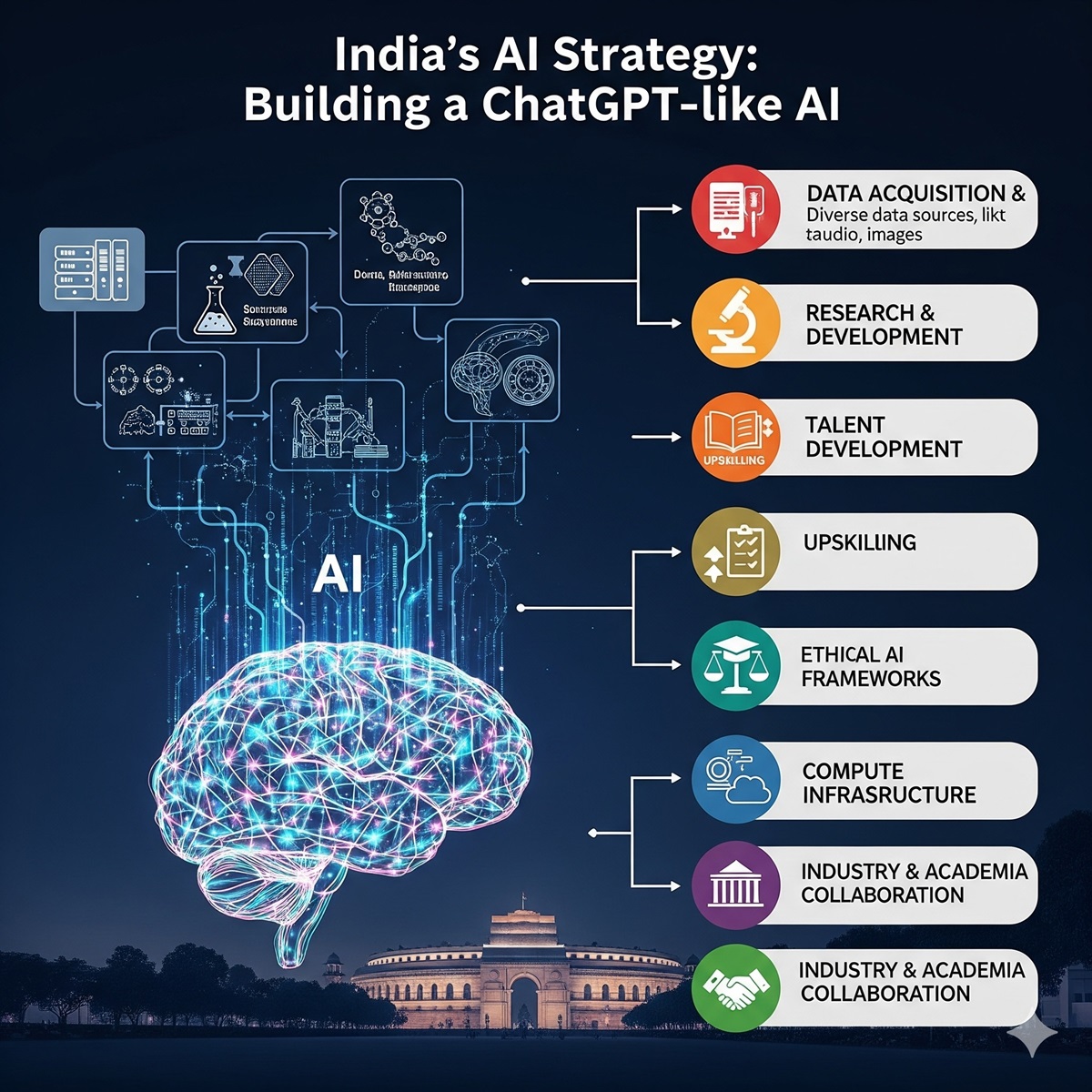
if India wants to build its own AI like ChatGPT, the decision between using open-source LLMs versus creating a model from scratch depends on time, cost, talent, and strategic goals. Let me break it down carefully:
Option 1: Using Open-Source LLMs
Pros:
-
Faster Development
-
Models like LLaMA, Mistral, Falcon are already trained.
-
Can be fine-tuned for Indian languages or domain-specific tasks in weeks/months.
-
-
Cost-Effective
-
Training from scratch can cost tens of millions of dollars.
-
Fine-tuning + hosting is much cheaper.
-
-
Proven Architecture
-
Transformers, RAG, LoRA/QLoRA are battle-tested.
-
Less risk of catastrophic failure.
-
-
Flexible for Domains
-
Government jobs, education, healthcare, local language support.
-
-
Easier to Scale
-
Start with 7–13B parameter models, scale later.
-
Cons:
-
Dependence on foreign models (licensing may restrict commercial use in some cases).
-
May need careful data curation to reduce bias or hallucination.
Option 2: Building from Scratch
Pros:
-
Complete Control
-
Ownership of model weights, architecture, and IP.
-
No licensing restrictions.
-
-
Tailored for India
-
Train for multiple Indian languages and cultural context from day one.
-
Can include Indian government data, local knowledge, and policies.
-
Cons:
-
Extremely Expensive
-
Training a GPT-4/ChatGPT-scale model costs hundreds of millions USD.
-
Requires thousands of high-end GPUs for months.
-
-
Time-Consuming
-
Dataset curation, training, and evaluation could take years.
-
-
Talent Bottleneck
-
Requires top AI researchers, ML engineers, and infrastructure specialists.
-
-
High Maintenance
-
Continuous retraining, scaling, safety, and alignment are complex.
-
Recommended Approach for India
-
Phase 1: Open-Source + Fine-Tuning
-
Use LLaMA, Mistral, Falcon, fine-tune on Indian datasets.
-
Add RAG to integrate official Indian knowledge (govt portals, policies, legal data).
-
Support multiple Indian languages.
-
Launch as a national AI assistant MVP quickly.
-
-
Phase 2: Hybrid Approach
-
Gradually invest in building proprietary models for critical domains (Gov data, language support, security).
-
Keep open-source LLMs as fallback or base model for cost efficiency.
-
-
Phase 3: Large-Scale National Model
-
After years of data collection and expertise, consider full-scale national model, similar to GPT-4, trained from scratch.
-
Bottom Line
✅ For immediate deployment: open-source LLMs + fine-tuning is the practical and cost-effective choice.
⚠️ Building a ChatGPT-scale model from scratch without years of preparation and billion-dollar budget is not feasible for now.
Here’s a comprehensive India AI Strategy Blueprint for building a ChatGPT-style AI, broken down into short-term, medium-term, and long-term goals. It focuses on practical steps, cost, tech stack, and infrastructure.
India AI Strategy: National LLM Roadmap
Phase 1: Short-Term (1–2 Years)
Goal: Deploy an MVP AI assistant using open-source LLMs.
Key Actions
-
Select Base Models
-
Open-source: Mistral 7B, LLaMA 3 (with commercial permission), Falcon 7B/13B.
-
Fine-tune for Indian context (govt portals, exams, legal, multilingual data).
-
-
Data Collection
-
Government websites, legal texts, educational content.
-
Convert into instruction-response pairs for fine-tuning.
-
Include multilingual support: Hindi, Telugu, Tamil, Bengali, Kannada, etc.
-
-
Fine-Tuning & Optimization
-
Use LoRA / QLoRA for low-cost domain adaptation.
-
Quantize models (4-bit / 8-bit) for efficient GPU hosting.
-
-
Hosting & Deployment
-
Use cloud GPU services (AWS, GCP, RunPod) initially.
-
Expose model via API for chat, Q&A, document search.
-
-
User Access
-
Web-based chat UI or mobile app.
-
Free + subscription tiers for advanced features.
-
Focus on public services, education, and government info.
-
Expected Outcome:
-
Fully functional Indian AI assistant.
-
Multilingual support.
-
Reduced reliance on foreign AI services.
Phase 2: Medium-Term (3–5 Years)
Goal: Build proprietary LLM components and scale AI nationally.
Key Actions
-
Custom Training Pipeline
-
Collect national datasets: government reports, local literature, regional content.
-
Use open-source models as initial checkpoints.
-
Fine-tune & gradually train larger custom models (13B–30B parameters).
-
-
RAG (Retrieval-Augmented Generation)
-
Integrate national knowledge bases.
-
Fact-checking layer for official data verification.
-
-
National AI Infrastructure
-
Establish GPU clusters or AI supercomputing facilities.
-
Optimize inference (vLLM, TGI, multi-GPU distribution).
-
-
Government & Enterprise Adoption
-
Deploy in education, healthcare, public info portals.
-
Provide APIs to developers for Indian applications.
-
Expected Outcome:
-
Semi-proprietary AI model with Indian context.
-
Reliable, faster, and scalable AI for government and citizens.
Phase 3: Long-Term (5–10 Years)
Goal: Build India’s fully independent LLM comparable to ChatGPT/GPT-4.
Key Actions
-
Develop Large-Scale Proprietary LLM
-
50B–100B+ parameters.
-
Trained on nationally sourced multilingual data.
-
Full control over architecture, weights, and IP.
-
-
Infrastructure
-
Multi-PB dataset storage.
-
National GPU supercluster for training & inference.
-
Redundant, secure, and high-availability deployment.
-
-
Advanced Features
-
Multimodal AI: text, audio, video, image understanding.
-
Government-specific modules: e-governance, education, health advisory.
-
Open API for Indian developers and startups.
-
-
National AI Governance
-
Safety protocols, content moderation.
-
Ethical AI aligned with Indian laws and culture.
-
Regulatory oversight for fairness, bias, and misinformation.
-
Expected Outcome:
-
India’s fully independent LLM with national data sovereignty.
-
Supports multiple languages and domains.
-
Ready for global collaboration while remaining locally controlled.
Strategic Recommendations
-
Start Small, Scale Fast
-
Open-source models allow rapid MVP deployment.
-
Use initial MVP to collect user feedback and improve model relevance.
-
-
Focus on Multilingual & Local Context
-
Indian languages + government knowledge = competitive advantage.
-
Supports adoption across public services.
-
-
Hybrid Approach
-
Open-source models as base.
-
Gradually build proprietary components to reduce dependency on foreign AI.
-
-
Invest in Talent & Infrastructure
-
AI researchers, ML engineers, NLP experts.
-
National GPU/cloud infra for training and hosting large models.
-
✅ Summary Visual Flow
Medium-Term (3–5 yrs)
└─ Proprietary LLM components + RAG + National GPU infra → Scalable AI
Long-Term (5–10 yrs)
└─ Full-scale India LLM (50B–100B+) → Independent, multilingual, multimodal AI
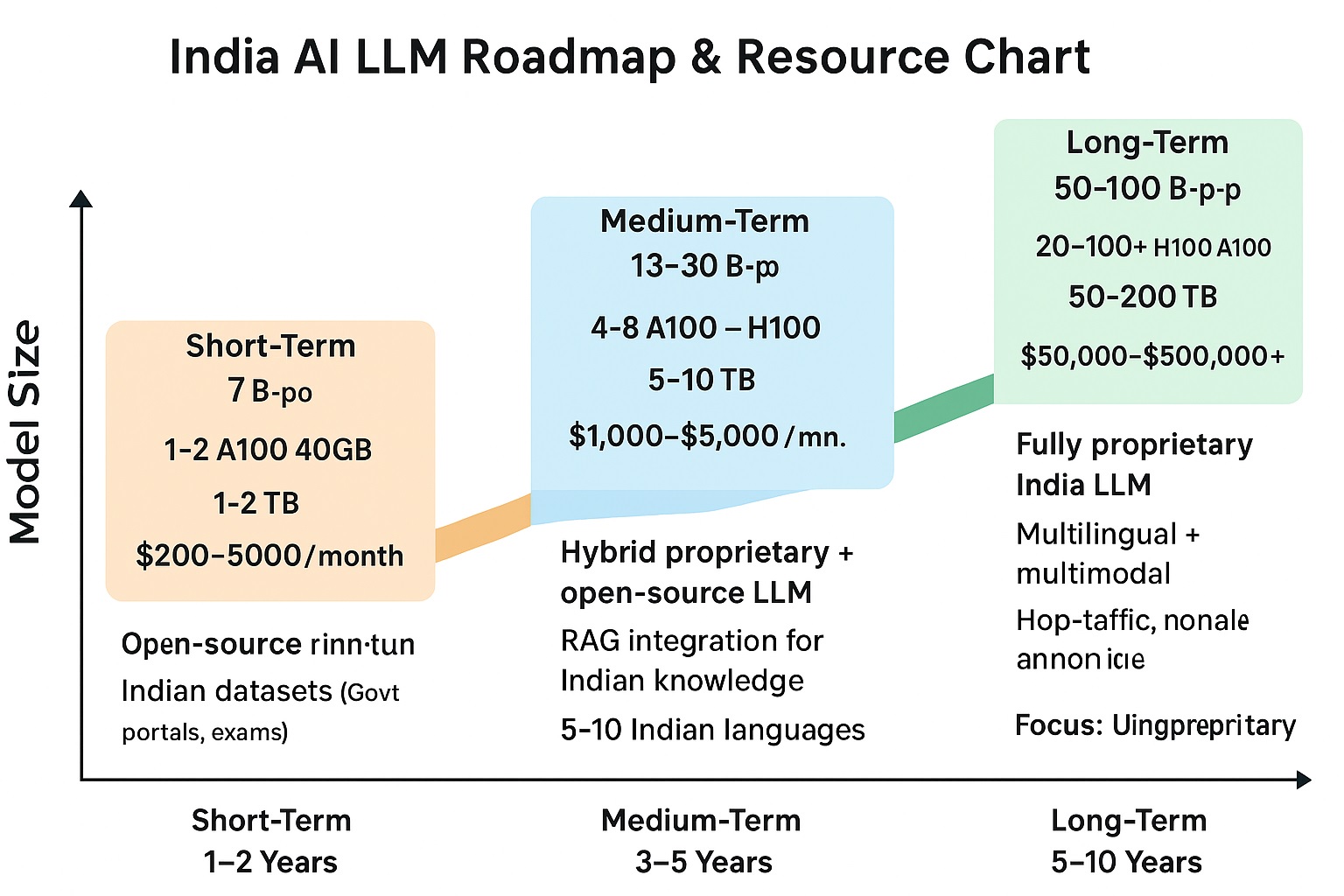
Here’s a detailed cost and resource estimate table for building an India-style ChatGPT LLM in short-term (MVP), medium-term, and long-term stages. This includes GPU requirements, storage, cloud costs, and timeline estimates.
India AI LLM Cost & Resource Estimates
| Stage | Model Size | GPUs Needed | Storage Needed | Monthly Cloud Cost (Approx.) | Timeline | Notes |
|---|---|---|---|---|---|---|
| Short-Term MVP (1–2 yrs) | 7B parameters | 1–2 A100 40GB | 1–2 TB | $200–$500 | 2–3 months | Open-source LLM (Mistral/LLaMA), fine-tuned on Indian datasets, 1–2 languages. MVP accessible via API/UI, low traffic. |
| Medium-Term (3–5 yrs) | 13B–30B parameters | 4–8 A100/H100 | 5–10 TB | $1,000–$5,000 | 6–12 months | Hybrid model: custom fine-tuning + RAG for multiple domains, multilingual support, moderate traffic, enterprise access. |
| Long-Term (5–10 yrs) | 50B–100B+ parameters | 20–100+ H100/A100 GPUs | 50–200 TB | $50,000–$500,000+ | 1–3 years | Fully proprietary India LLM, multilingual, multimodal, high traffic (millions of users), national-scale deployment. Requires GPU clusters, PB-scale storage, redundancy. |
Additional Notes
-
GPU Type
-
A100 40GB: Cost-effective for 7B–13B fine-tuning.
-
H100 80GB: Needed for 30B–100B models for faster training/inference.
-
-
Storage
-
Include embeddings for RAG, training datasets, fine-tuned weights.
-
For long-term: consider S3 + HDFS hybrid.
-
-
Cloud vs On-Prem
-
MVP and medium-term: cloud GPUs are cheaper/flexible.
-
Long-term: India may consider national AI supercluster to reduce recurring cloud cost.
-
-
Personnel
-
Short-term: 2–5 AI/ML engineers.
-
Medium-term: 10–20 engineers, NLP researchers, data engineers.
-
Long-term: 50+ team including ML ops, AI ethics, model safety experts.
-
-
Cost Saving Techniques
-
Use LoRA/QLoRA for fine-tuning instead of full training.
-
Use quantization (4-bit/8-bit) for inference.
-
Cache frequent queries to reduce GPU usage.
-
-
Revenue / Sustainability
-
Medium & long-term: subscription models, API monetization, government licensing.
-
Helps offset infrastructure and personnel cost.
-
Summary
-
MVP (7B): <$500/month, fast deployment, ideal for testing AI utility.
-
Medium-Term (13–30B): ~$1k–$5k/month, regional-scale adoption.
-
Long-Term (50–100B): $50k–$500k/month+, national-scale independent AI with Indian language support.
Here’s a visual roadmap and resource chart for building an India-style ChatGPT AI. I’ve combined timeline, model size, GPU needs, storage, and cloud cost into a single easy-to-read diagram.
India AI LLM Roadmap & Resource Chart
───────────────────────────────────────────────
Medium-Term | 3–5 Years
───────────────────────────────────────────────
Model Size: 13B–30B params
GPUs: 4–8 x A100/H100
Storage: 5–10 TB
Cloud Cost: ,000–,000 / month
Focus: Hybrid proprietary + open-source LLM
RAG integration for Indian knowledge
Multilingual support (5–10 Indian languages)
Goal: Scalable AI for enterprise & government services
───────────────────────────────────────────────
Long-Term | 5–10 Years
───────────────────────────────────────────────
Model Size: 50B–100B+ params
GPUs: 20–100+ x H100/A100
Storage: 50–200 TB
Cloud Cost: ,000–,000+ / month
Focus: Fully proprietary India LLM
Multilingual + multimodal (text, image, audio)
High-traffic national deployment
Goal: Independent Indian AI, full control, global-standard performance
Key Takeaways
-
Phase Approach: Start with MVP using open-source LLM, scale progressively.
-
Cost Efficiency: Use LoRA/QLoRA, quantization, and caching to reduce GPU costs initially.
-
Focus Areas: Indian datasets, multilingual support, domain-specific adaptation (Govt, education, healthcare).
-
Team & Talent: Start small, gradually expand AI researchers, ML engineers, and infrastructure experts.
-
Long-Term Goal: Build a nationally owned LLM capable of replacing reliance on foreign AI while serving Indian citizens.
