building an AI search engine like Google is huge, exciting, and doable in stages. Below I’ll give you a practical, technical, product, and business roadmap you (or a small team) can follow — from a minimal AI-powered search MVP to a full-scale, competitive product. I’ll keep it pragmatic: concrete components, open-source options, timelines, costs, KPIs, and risks.
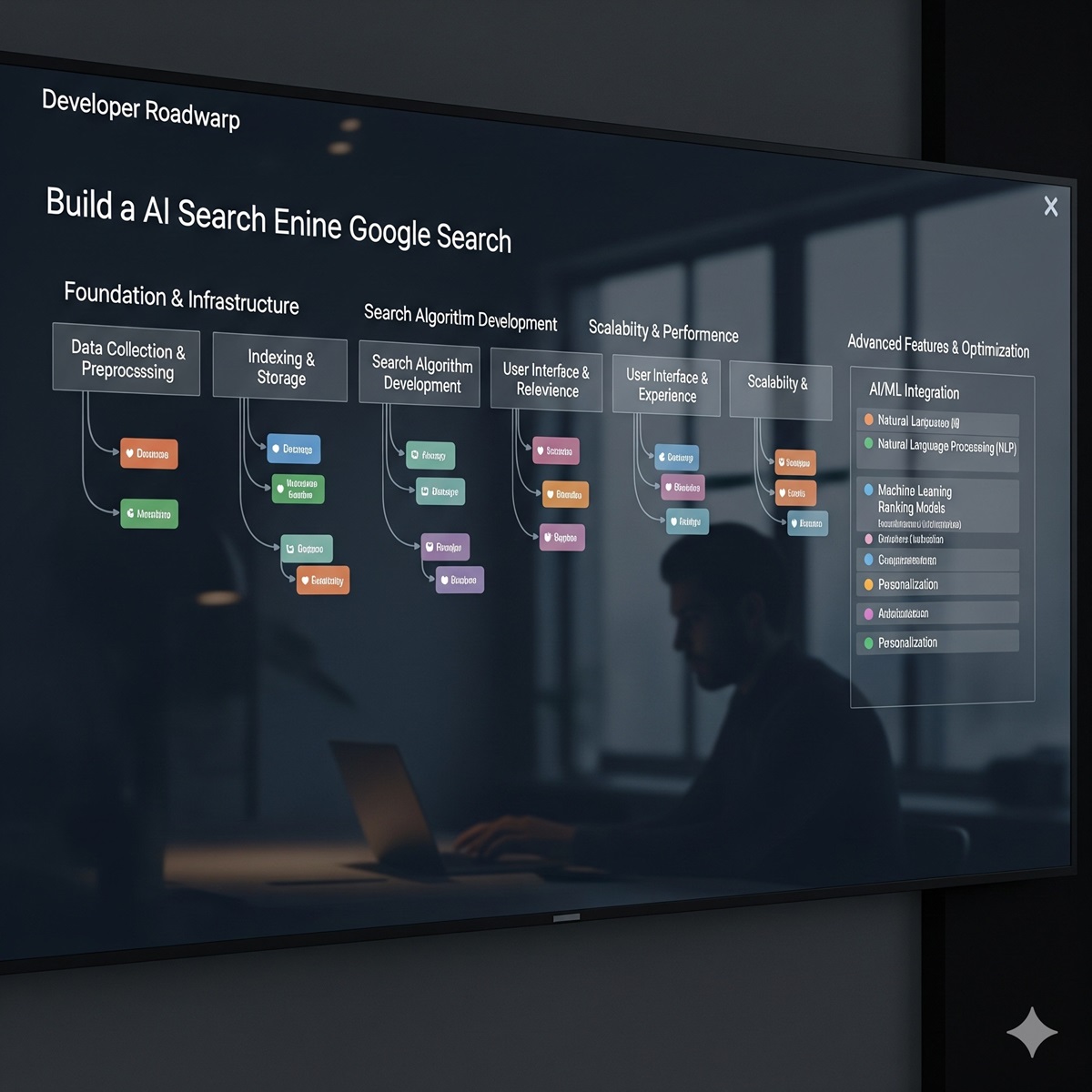
1) What “AI Search” means here
An AI search engine = search experience built on:
-
Traditional IR (index + retrieval + ranking) for recall & speed, plus
-
Neural / vector retrieval + LLMs for semantic matching, query understanding, and generative answers (summaries, citations, conversational follow-up).
Goal: replace / augment classic blue-link search with fast, accurate, contextual, and trustworthy answers (and still serve links for verification).
2) High-level architecture (layers)
-
Crawl & Ingest
-
Web crawl (focused seed + broad crawl), third-party datasets (CommonCrawl, Wikipedia), curated datasets (news, govt sites, local language corpora).
-
-
Document processing
-
HTML cleaning, boilerplate removal, metadata extraction, canonicalization, language detection, segmentation (passages).
-
-
Indexing
-
Inverted index for keyword search (Elasticsearch, OpenSearch, Vespa).
-
Dense vector index for semantic retrieval (FAISS, Milvus, Pinecone, Weaviate).
-
-
Retrieval
-
Hybrid retrieval: lexical (BM25) + vector (ANN) → candidate set.
-
-
Ranking
-
Lightweight learning-to-rank (LTR) model + neural re-ranker (cross-encoder) for relevance/scoring.
-
-
Answer generation
-
LLM-based summarization / Q&A over retrieved docs (RAG — retrieve & generate). Must include citations & provenance.
-
-
Serving & UI
-
Web + mobile, search boxes, conversational chat UI, verticals (images, videos, news).
-
-
Monitoring & safety
-
Quality metrics, feedback loop, human reviewers, abuse detection.
-
-
Analytics & personalization
-
Session context, user signals, personalization while preserving privacy.
-
3) Open-source / tech choices (practical stack)
-
Crawl: Scrapy, Apache Nutch, or use CommonCrawl snapshots. (For scale: custom crawler on Kubernetes.)
-
HTML processing: Readability, jusText, boilerplate removal libraries.
-
Keyword index: Elasticsearch / OpenSearch or Vespa (Vespa has first-class search + ML ranking).
-
Vector DB / ANN: FAISS (self-host), Milvus, Weaviate, or managed Pinecone/Anthropic DB.
-
Embedding models: Open-source encoders (e.g., sentence-transformers, SBERT, LLaMA-based encoders). Choose language-aware models for Indian languages.
-
Large Language Models (for RAG, summarization):
-
On-prem / open models: Llama 2 / 3 family, Mistral, Falcon, or specialized instruction-tuned models.
-
Managed: OpenAI, Anthropic, Cohere for faster iteration (but vendor lock / costs).
-
-
Re-ranker: Cross-encoders (tiny transformer models), trained via supervised pairwise loss.
-
Serving: FastAPI / Node.js, Kubernetes, Redis cache, CDN (CloudFront/Cloudflare).
-
Observability: Prometheus, Grafana, Sentry.
-
Data labeling / evaluation: Label-studio, crowdsourcing (internal raters).
4) MVP scope (what to build first)
Objective: launch an AI search MVP that returns topical links + short generated answers with citations.
MVP features:
-
Query box + results page (10 blue links).
-
Hybrid retrieval (BM25 + vector) for better semantic matches.
-
LLM-based concise summary (1–3 sentences) with 1–3 source links beneath (always cite!).
-
Freshness filter (news / last 24h).
-
Basic analytics and feedback (thumbs up/down).
-
Support for English + 1–2 major Indian languages (Hindi, maybe Telugu/Bengali later).
Why this MVP? It proves the key value — better answers + links — without needing full-scale crawling.
5) 30 / 90 / 365 day execution plan
30 days — Prototype
-
Pick datasets: CommonCrawl sample + Wikipedia + curated news/gov pages.
-
Build a simple pipeline: ingest → clean → BM25 index (Elasticsearch) + embeddings (sentence-transformers) + FAISS.
-
Implement retrieval: BM25 + vector hybrid → candidate set.
-
Integrate small LLM (open-source or managed) for answer generation via RAG (use top-3 docs).
-
Simple UI (search box + results + generated answer).
Team: 1 full-stack engineer + 1 ML engineer (or a very capable solo dev).
Outcome: Working demo, limited corpus, low traffic.
90 days — Beta
-
Expand crawl coverage (domain expansion, more verticals).
-
Add ranking: train simple LTR with manual labels (click data simulated).
-
Add language support, simple query understanding (query rewriting, intent detection).
-
Add feedback collection & human-in-the-loop moderation.
-
Costing & infra: deploy on small K8s cluster, S3 for storage, managed vector DB optionally.
Team: 2–4 engineers, 1 ML engineer, 1 infra/DevOps.
Outcome: Beta with 10–100k queries/day capability.
365 days — Product/Scale
-
Productionize crawler, incremental updates, fresh indexing.
-
Implement advanced ranking (neural re-ranker), personalization, session understanding, multi-modal (images/video) retrieval.
-
Invest in model training/fine-tuning for Indian languages and domain-specific relevancy.
-
Build scalable infra (multi-region, edges, caching).
-
Launch public beta, start monetization tests (ads, search partnerships).
Team: 8–25 engineers + SRE + ML + product + content moderation + legal.
Outcome: Reliable product at scale with measurable retention.
6) Estimated costs (very rough)
-
Prototype (30 days): $1k–5k (cloud credits, using managed LLM APIs short-term).
-
Beta (90 days): $10k–50k (compute for embeddings, small cluster, managed services).
-
Year-1 production: $200k–$2M depending on scale and whether you self-host LLMs (which is expensive for training/inference).
-
Major cost drivers: hosting videos/large content, LLM inference, human labeling & moderation.
7) Team & hiring (minimum for serious product)
-
Product Manager (1)
-
ML Engineers (2–4) — ranking, embeddings, LLM prompt engineering
-
Backend Engineers (2–4) — indexing, retrieval infra, APIs
-
Frontend Engineers (1–2) — UI/UX, web/mobile experience
-
SRE/DevOps (1–2) — infra automation, scaling
-
Content Moderation & Trust (2–6) — policies, human review
-
Data Labelers / Raters (contracted)
Solo/Small-team path: start with 1–2 engineers and iterate using managed APIs & prebuilt stacks; hire as traction grows.
8) Key technical decisions & tradeoffs
-
Use managed LLMs vs self-host
-
Managed = faster to ship, predictable quality, recurring cost.
-
Self-host = control, lower long-run cost if you scale, but large upfront infra & engineering cost.
-
-
Vector DB choice: self-host FAISS for cost control or use managed (Pinecone, Milvus Cloud) for ease.
-
Crawl breadth: focused verticals first (news, tech, legal, government) — easier to deliver high-quality answers.
9) Relevance, trust & safety (non-negotiable)
-
Always cite sources for generative answers — display links and quoted snippets.
-
Build source provenance: show which exact passage the LLM used.
-
Implement conflict detection: when retrieved docs disagree, show alternatives and let user inspect.
-
Rate-limit or block hallucinations: use verification model that checks generated claims against retrieved documents.
-
Content policy & appeals process for takedown requests.
-
GDPR/Indian privacy rules: data retention, opt-outs, transparency.
10) Evaluation metrics (what to measure)
-
Relevance: NDCG@10, MRR, Precision@k (requires labeled data).
-
Answer quality: human evaluation (accuracy, helpfulness, hallucination rate).
-
Latency: P95 query latency target <300–500ms for search; LLM answers may be async with spinner.
-
Coverage & Freshness: number of domains indexed; time to reflect new content.
-
User metrics: CTR, dwell time, repeat users, task success rate.
11) Monetization & go-to-market
-
Ads (native search ads, contextual).
-
Vertical partnerships (travel, jobs, classifieds).
-
Enterprise APIs (search-as-a-service for publishers).
-
Data products (analytics for publishers) — be careful with privacy.
Go-to-market: start country or language-specific (e.g., India + Indian languages) to exploit local signals and less direct competition initially.
12) Risks & mitigation
-
Hallucinations / Misinformation → rigorous provenance, conservative answers, fallback to “I don’t know.”
-
Copyright / legal → respect robots.txt, implement takedown flows, keep logs.
-
Cost of LLM inference → cache answers, distill models, use smaller models where possible.
-
Competition → compete on local relevance, trust, vertical depth, language support.
13) Concrete next steps (for you right now)
-
Pick a vertical & language (e.g., Indian news + Hindi + English).
-
Prototype retrieval + RAG on a small corpus (CommonCrawl + news) using Elastic + FAISS + an open LLM or managed API.
-
Build a simple UI and measure user satisfaction (5–10 early testers).
-
Iterate ranking & provenance until hallucination rate < X% (your threshold).
-
Plan infra scale & cost for the first 100k queries/day.
-
A 30 / 90 / 365 day technical sprint plan (who does what, outcomes).
-
A starter repo layout + file list (what to commit first).
-
Code snippets (Python) for a minimal hybrid retrieval + RAG pipeline using:
-
Elasticsearch (BM25) + FAISS (dense vectors) hybrid retrieval, and
-
an LLM call for generation (can be OpenAI or a self-hosted model later).
-
I’ll also recommend production options (managed vs self-hosted), give cost signposts, and cite sources for the main infra choices.
1) 30 / 90 / 365 day technical sprint plan (practical)
30-day prototype (ship a working demo)
Goal: searchable corpus + short AI answers with citations.
Week 1
-
Pick vertical & seed corpus (news + Wikipedia + 2–5 authoritative domains).
-
Repo bootstrap:
ingest/,index/,api/,web/. -
Standup: solo or 2 people (engineer + ML).
Week 2
-
Build document cleaning pipeline (boilerplate removal, language detect, split into passages).
-
Index passages into Elasticsearch (BM25).
-
Create embeddings with sentence-transformers and index vectors into FAISS. (FAISS is established for efficient vector NN.) GitHubFaiss
Week 3
-
Implement hybrid retrieval: BM25 top-k + FAISS top-k → merge candidates.
-
Wire a simple RAG: send top 3 passages + query to an LLM prompt template and return generated answer + source links.
-
Build quick React/Vue web UI with search box + answer + “sources” list.
Week 4
-
User tests (10–20 users), measure quality, fix obvious hallucinations (show sources under generated answer).
-
Deployment: small k8s or single EC2; autoscale later.
Outcome: interactive demo that returns links + a short LLM answer with provenance.
90-day beta (stabilize + expand)
Goals: expand corpus, ranking, metrics, language support.
Month 2
-
Add incremental crawl (news + selected sites).
-
Implement feedback loop (thumbs up/down) + simple LTR model training for ranking. Consider Vespa or Elasticsearch LTR if you scale. (Vespa unifies retrieval + ML ranking—useful later). Vespa.ai+1
Month 3
-
Improve reranker (cross-encoder) for final ranking.
-
Add caching & answer deduplication to reduce LLM calls.
-
Add Hindi (or chosen language) pipelines — embeddings & language models for query understanding.
Outcome: stable beta, 10k–100k queries/day capability with monitoring.
365-day production (scale & productize)
Goals: production crawling, ranking, cost optimization, privacy & safety.
Quarter 3–4
-
Full crawler (Kubernetes, distributed), incremental doc updates.
-
Move vector index to production-grade: self-hosted FAISS on GPU or managed Pinecone/Milvus. (Managed Pinecone simplifies ops but has baseline monthly cost.) PineconePinecone Docs
-
Implement neural re-rank, online learning (CTR signals), personalization.
-
Build provenance checks: verification model to compare LLM answer vs retrieved docs.
-
Add Trust & Safety, compliance, takedown workflows, and enterprise / ads flows.
Outcome: production search with robust ranking, citation-backed answers, monitoring, and monetization paths.
2) Starter repo layout (what to commit first)
Commit in this order: README, infra/docker-compose.yml (ES + Redis + small server), ingest/extractor.py, index/es_loader.py, index/embeddings.py, index/faiss_index.py, api/app.py, web/ui.
3) Minimal hybrid retrieval + RAG — code snippets
These are ready-to-drop-in Python scripts (no runtime here). They use
sentence-transformers,elasticsearch-py, andfaiss. Swap the LLM call to your provider.
1) Create embeddings (sentence-transformers)
2) Index passages into Elasticsearch (BM25)
3) FAISS index (dense vectors)
4) Hybrid retrieval (BM25 + FAISS merge)
5) RAG / Generation (LLM prompt)
Notes: replace
OPENAI_KEYandmodelwith your preferred provider or self-hosted LLM endpoint. Keep the LLM answer short and always append thecontextsource links under the answer to avoid hallucination risk.
4) Production choices & cost signposts
-
FAISS (self-hosted): inexpensive (open-source) but you must manage GPU/CPU for ANN at scale. Good for total control. GitHubFaiss
-
Pinecone (managed vector DB): fast to production, easier ops, but has baseline monthly costs (Pinecone shows entry plans and $50/month minimum for standard tiers). For prototypes you’ll pay more than self-hosted small FAISS, but save engineering time. PineconePinecone Docs
-
Vespa: an open-source unified platform that supports hybrid retrieval + ML ranking and real-time inference—great if you expect complex ranking logic early. Consider Vespa when you reach production re-rank scale. Vespa.ai+1
Cost ballpark (year 1):
-
Prototype (small corpus, low traffic): $1k–5k (cloud VMs, S3, occasional LLM API calls).
-
Beta (10k–100k QPS/day not realistic at low budget; say 10k queries/day): $10k–50k (vector DB, some managed LLM usage, infra).
-
Production (100k+ queries/day; own inference): $200k–2M+ depending on whether you self-host models, use GPUs, and traffic patterns.
5) Evaluation & safety (must-haves)
-
Always show the sources used by the LLM (link + snippet).
-
Add a lightweight verification step (check generator claims against retrieved docs; if low-confidence, show sources without generated assertion).
-
Maintain logging for each answer (query, docs used, model response) for audits and takedown requests.
6) Quick recommendations for you (next actions I can do immediately)
-
If you want I’ll:
-
Create a detailed 30/90/365-day sprint board (task-by-task with priorities).
-
Produce a starter Docker compose that runs Elasticsearch + Redis + small FastAPI app + FAISS (dev mode).
-
Draft the exact LLM prompt templates and a small evaluation rubric (human labeling sheet) you can use to measure hallucination rates. https://chatgpt.com/c/68bc1901-7620-832f-b017-ef920d4540e8
-
